

Assets
If you need step-by-step instructions, see Working with assets. For the full list of fields, tabs, and conditions, see the Assets reference.
An asset is the central object in UNIO24. The other processes are built around it: transfers, checking out to employees, service, audits, and tickets. Each asset is described by a card and at any moment is held by a single owner — in a location or with an employee.
What an asset is
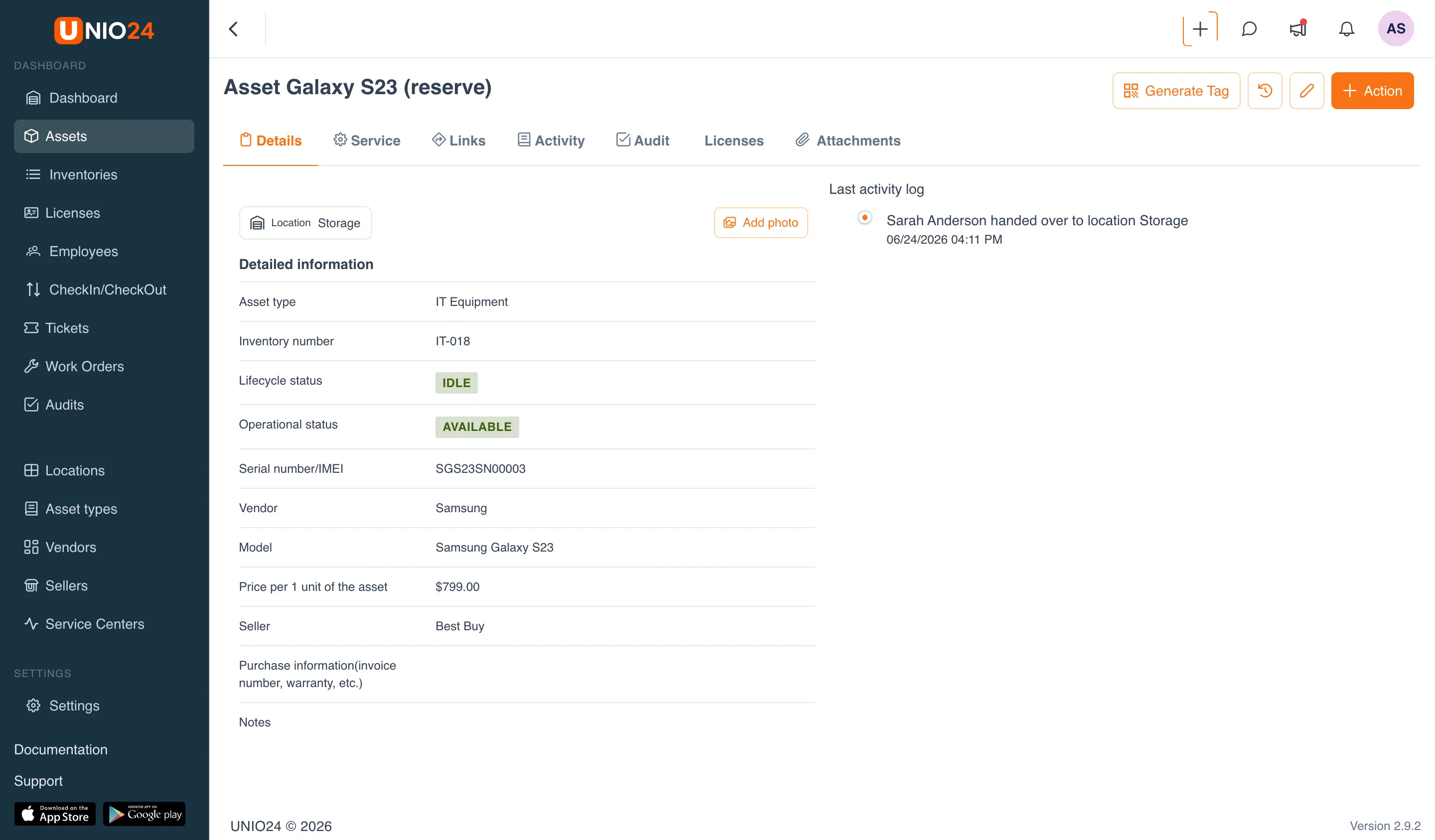
Section titled “What an asset is”An asset is a unit of accounting: equipment, hardware, furniture, tools, and the like. An asset has an inventory number, a type, and a current owner. The asset list opens from the Assets item in the left menu.
The set of an asset’s fields depends on its asset type. The type determines which fields appear in the form and on the card — for example, the serial number, vendor, model, dates, price. Asset types and their fields are configured in the settings section, see Asset types.
Card structure
Section titled “Card structure”An asset card consists of a header with actions and a set of tabs:
- Details — the main information: type, inventory number, statuses, condition, asset type fields, custom fields, current owner, and the latest activity.
- Service — records of sending to and returning from service, warranty and post-warranty repairs.
- Links — parent and child assets (hierarchy).
- Activity — operations on the asset.
- Audit — the asset’s participation in audits (the tab is visible if you have permission to view audits).
- Licenses — related licenses (the tab is visible if the licenses module is enabled).
- Attachments — files attached to the asset: contracts, warranty cards, invoices, manuals. See Files and photos.
In addition, the asset page has a photo gallery — photos of the asset itself, as well as photos taken in related work orders and audits.
For the detailed contents of each tab, see the Assets reference.
Statuses and condition
Section titled “Statuses and condition”An asset has several characteristics that describe its current state:
- Lifecycle — the asset’s stage (for example, “Active,” “In Maintenance,” “Pending Disposal,” “Disposed”).
- Operational status — a more precise state within the lifecycle stage.
- Condition — the physical condition of the asset (for example, “New,” “Good,” “Damaged”), which is recorded on check-in and during audits.
The sets of statuses and conditions are configured by the administrator, see Asset statuses and conditions. The set of available actions also depends on the lifecycle: for example, for an asset with the “Pending Disposal” status the action menu is empty.
Owner: location or employee
Section titled “Owner: location or employee”An asset is always either in a location or with an employee. The owner is set when the asset is created and changes through check-out, check-in, and transfer operations. The current owner is visible on the card and in the asset list. For more on these operations, see Asset operations.
Hierarchy: parent and children
Section titled “Hierarchy: parent and children”Assets can be linked into a “parent — child” hierarchy. For example, a monitor and a keyboard are attached to a system unit. Links are visible on the Links tab, and in the asset list the parent expands to show the nested assets.
Nesting depth is limited: child assets can be added up to a certain level, after which the system reports that the maximum nesting level has been reached. Child assets move together with the parent: if they were in another place, when linking, the system will warn that they will be moved to the parent’s owner.
Change history
Section titled “Change history”The system keeps a history of changes to the asset’s fields: who changed which values and when. The history opens with the History of changes button on the card. This is separate from the Activity tab, which shows operations (check-out, transfer, service) rather than field edits.