

Audits
For step-by-step instructions, see Running an audit. For the full list of fields, columns, and values, see the Audit reference.
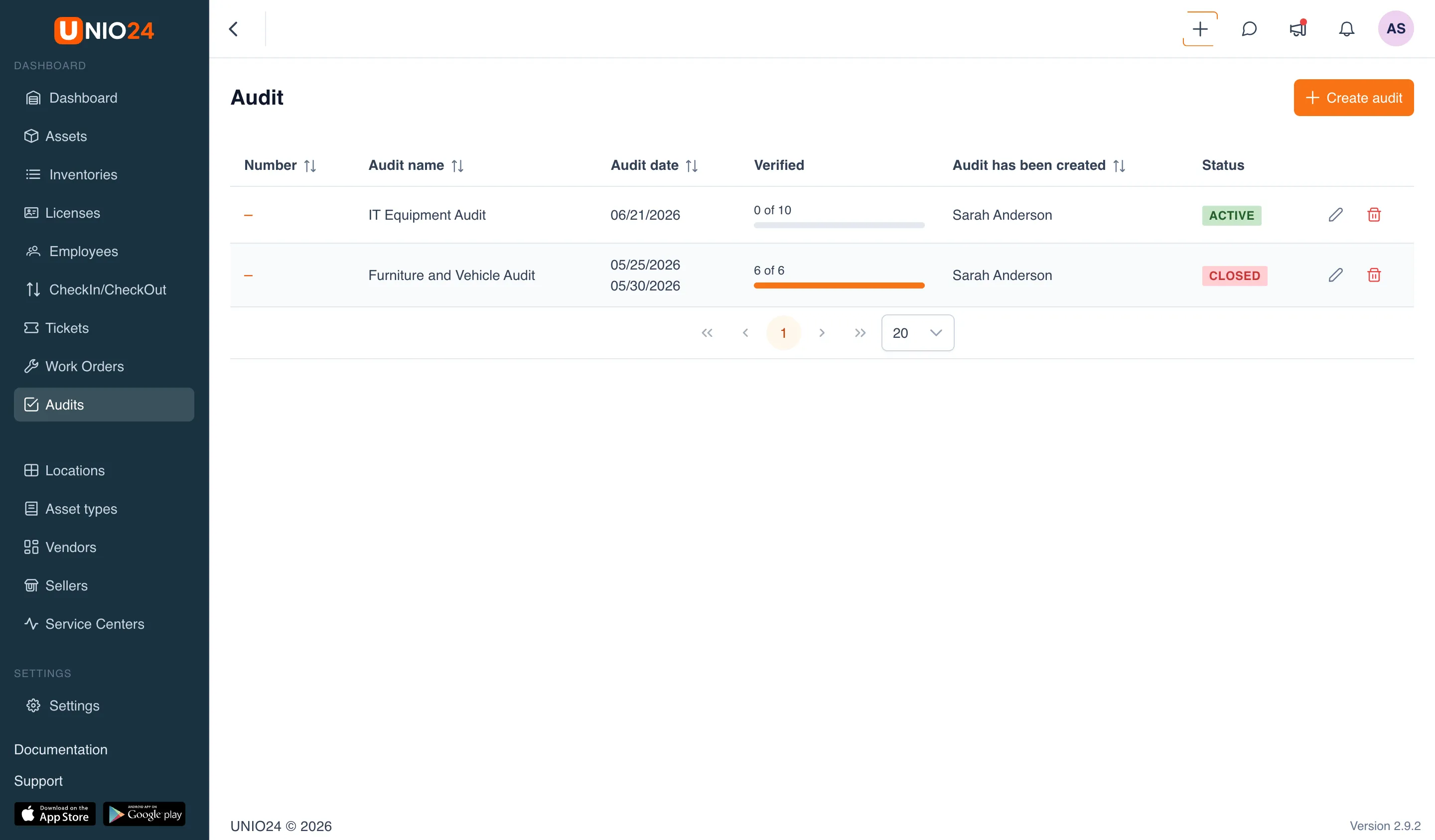
An audit confirms that assets are where they should be and records their condition. In the menu and on the pages themselves this section is called Audit, and the create button is Create audit.
Audits and the Inventory module
Section titled “Audits and the Inventory module”Do not confuse an audit with the Inventory menu item. An audit checks your registered assets: you verify whether each asset is in place. Inventory is a separate module for tracking consumables by quantity, not an item-by-item check.
Audit scope
Section titled “Audit scope”When you create an audit, you choose its source — which assets are included in the check:
- All — all of the organization’s assets.
- By location — assets at the selected locations.
- By subdivision — assets of the selected subdivisions.
- By employee — assets assigned to the selected employees.
The source is set once at creation and cannot be changed after saving. From the selected scope the system builds a list of assets to check.
Condition assessment
Section titled “Condition assessment”If condition assessment is enabled for an audit, the checker marks the asset’s presence and specifies its condition. The set of conditions is configured in the “Asset Conditions” settings section; it includes system values (New, Good, Satisfactory, Poor, Damaged, Non-functional) and may have custom ones added. When condition assessment is required, an asset cannot be marked as present without selecting a condition.
Photo capture
Section titled “Photo capture”When checking an asset during an audit, you can attach photos to it — for example, to record its condition or its actual location. Such photos go into the asset’s own gallery with a note about their source. For more, see Files and photos.
Self-service audits
Section titled “Self-service audits”Usually an audit is run by a system user who opens its list of assets. But an audit can be made self-service: each employee then receives a personal link by email and confirms the assets assigned to them, without a UNIO24 account.
To protect such a link, you can enable an OTP code — a one-time confirmation code sent to the participant’s email. The progress of a self-service audit is visible to the organizer on the Members tab: who the email was sent to, what its status is, and how many assets have already been confirmed.
Where it is run
Section titled “Where it is run”An audit can be run in the web app or in the UNIO24 Mobile app, where assets are checked by scanning QR codes and NFC tags. See the mobile app overview.