

Employees
If you need step-by-step instructions, see Managing employees. For the full list of columns, fields, and statuses, see the Employees reference.
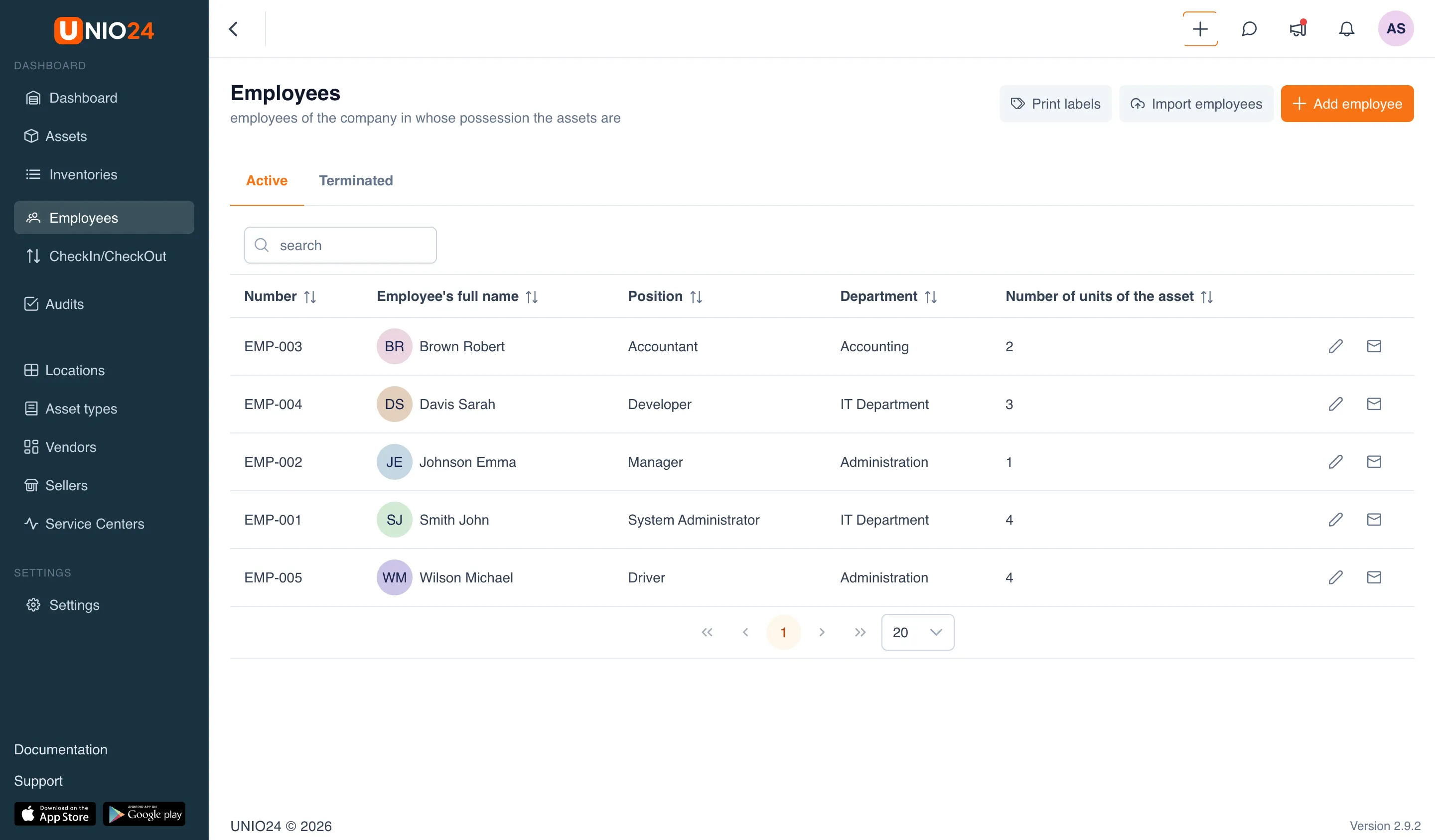
An employee is a record about a person who may be assigned an asset issued to them for work. An employee does not have to be a financially responsible person by company order: the directory exists mainly so you can see who holds an asset and who uses it. The section opens from the main menu on the left with Employees.
Employee vs. system user
Section titled “Employee vs. system user”An employee and a system user are different things.
- An employee is a record in the directory. By itself, an employee does not sign in and does not manage anything; assets are simply assigned to them.
- A system user is an account with an email, password, and role that gives access to the web and mobile app.
A single employee can be linked to a user account — for that, they are invited to the system by email. After that, the asset operations the person performs in the app are tied to their employee record. The invitation process itself is described in Managing users, and step by step in Managing employees.
In the employee list you can see whether a record has system access: next to the employee number is the Has system access icon (if the account is already active) or the Invited label (until the invitation is accepted).
Employees and assets
Section titled “Employees and assets”Assets are assigned to an employee through asset operations. An assigned asset is shown in the employee’s card, and the asset’s own card shows who holds it. The link works both ways.
On the employee card, each asset shows one of two statuses: with employee (the asset is in hand) or under repair (the asset is assigned to the employee but is currently in a service center). This is a simplified set of statuses for this section; the full asset lifecycle is described in Assets.
The number of assets in hand is shown in the employee list in the Number of units of the asset column. This counter does not include assets that sit in the employee’s responsible locations.
Responsible locations
Section titled “Responsible locations”Besides assets in hand, an employee can be designated as responsible for a location — for example, a warehouse or office. They are then responsible for all assets stored in that location, but these assets are not considered issued to them personally.
For this reason, they are tracked separately in the system: assets from responsible locations are not counted in the Number of units of the asset counter and do not appear in the employee’s activity history. You assign a person responsible for a location in the Locations section itself.
Employee card
Section titled “Employee card”The employee card gathers everything related to a person in one place. At the top is a block with the main information: avatar (or initials, if no photo is uploaded), full name, position, department, phone, and email. The avatar can be uploaded — see Files and photos. If the record has custom fields, they appear below this block.
Below are the tabs:
- Employee assets — the assets the employee currently holds, with their status.
- activity — the asset issues and returns this employee took part in.
- Location — responsible locations; the tab appears only if at least one location is assigned to the employee.
- Licenses — licenses assigned to the employee; the tab appears when the Licenses module is enabled. You can assign a license from the Action button menu in the card.
- Attachments — files attached to the employee (see Files and photos).
A detailed description of each tab’s content is in the Employees reference.
Offboarding an employee
Section titled “Offboarding an employee”When an employee leaves, they are not deleted but go through offboarding — a managed process that returns their assigned assets to the company, releases licenses, reassigns tickets and locations, and blocks system access.
Because of this, the employee list is split into two tabs — Active and Terminated — and the employee gets an employment status (active, offboarding in progress, terminated). How this works and how to run offboarding is described in Offboarding employees.